Virgil Griffith collected the ‘Favourite Music’ data of Facebook users from different US colleges, matched their corresponding genres to SAT scores and charted the link between music preference and intelligence. His findings are recorded below:

Quite a novel idea, but of course largely unscientific. His results are limitedly accurate (and quite haphazardly patterned as you can tell la), but I guess as an amateur attempt it does provide a rough overview of the kind of music you’re likely to listen according to your educational background.
I say educational background and not intelligence because,
1) SATs cannot best determine intelligence. And neither does most major exams for that matter but yeah whatevs. If you receive good education you’re likely to be well-prepped for SATs.
2) People of higher educational background socialize in circles where originality is prized so they tend to seek out more exclusive music, expanding their musical scope and are therefore more inclined to listen to ‘Alternative’ or ‘Indie’ or whatever else you call it. It is not that the less intelligent cannot appreciate these music. It is merely that they are not exposed to it.
So yes, not intelligence. Probably education.
Disregarding the above practical limitations, using personal experience I’ve established another hypothesis for this whole music/intelligence theory.
Hypothesis: Different music are not exclusive to different level of intelligence but rather, different TYPES mental faculties (i.e. physical, logical, emotional, social, creative, musical).
Let’s just assume I’m of just average intelligence (which I am not. Which is a pity because if I were of dumber I’ll provide a more balanced test subject. The perils of smartitude are boundless. Regardless.)
My music preference – by that meaning music I enjoy more so than others – ranges from T.I (0916) to Justin Timberlake to Modest Mouse to RHCP to Beatles and to Sufjan freaking Stevens all the way to Beethoven (though granted I listen to him only when I’m doing math or in the toilet).
A graphic aid:
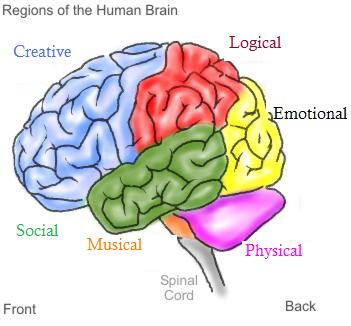
SATs are based largely on logical, and somewhat creative abilities of a person. The ones who excel for SATs are logical, adept at solving mathematical sums and mentally summarising information and/or conduct mini science experiments in their head during the period of examination. We naturally bridge that with the ‘highest scoring’ music by Beethoven.
The frequency, tone, nuances, pitch, and whatever other musical thingamajiga of Beethoven sends out alpha waves that happen to stimulate the red part of the brain that specializes in logical thinking.
Along these lines, apply a similar theory to all other aspects of intelligence to the appropriate mental faculty.
Physical has the least contribution to SAT scores, therefore shunted to the lowest end of the spectrum, casually assumed as the ‘dumb people’ music. Although I would agree that Lil’ Wayne does indeed induce a kind of migraine in me that resembles a severe massacre of braincells (and thereby landing first place in stupidlandofmusic), he is an accurate exception to the otherwise misperceived music of the ‘dumb’ category.
What does Beyonce, Ludacris, and T.I have in common besides their ridiculous stage names? Yes, they are all under the umbrella term of ‘Hip hop’, and all rank low on the SATs score measure. Besides that, they have significant thumping rhythms more commonly known as ‘sick beats’. This quality as we all know often excite people into dancing, evident with it’s popularity in dance clubs. The term ‘Hip hop’ is double used as the dance genre.
What does all that tell us? That such music stimulates nerves that involve physical movement.
Although unscientific, my proposition is highly probable. It possibly makes more sense than the whole intelligence with SAT scores thing. Of course, it’s merely a proposition and limited in a sense that I am the only reference in the entire hypothesis. Meaning all the assumptions based on education, intelligence, multiple mental talents and musical preference are drawn from me.
For those who are more observant, or perhaps ardent listeners to Beethoven and therefore able to quickly make logical conclusions, you have perhaps already determined what the hypothesis should be modified into in order to promote further accuracy to the cause.
This modified and more accurate hypothesis shall end my post for today.
Hypothesis that is very probably true: Based on her music preference and range, Weiqing is talented in all fields of the human capabilities.
The end.
 Q
Q 
Leave a comment