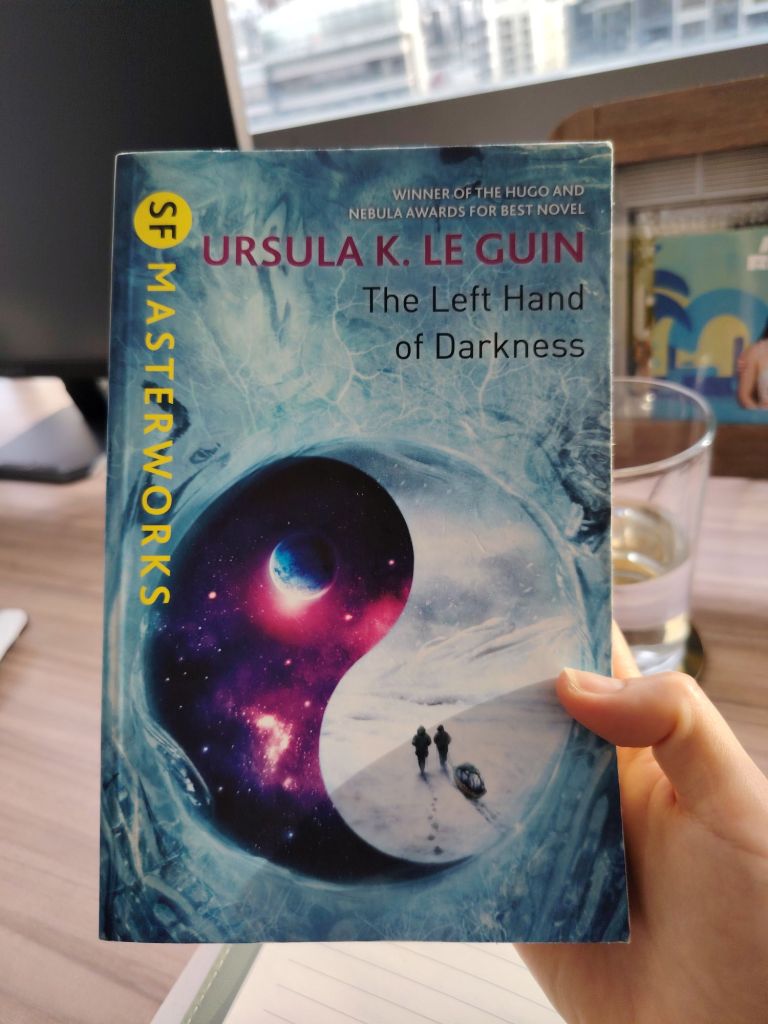
A reader online described the quality of Ursula K. Le Guin’s writing as ‘meditative’. An accurate encapsulation of her style: at once distanced, observational, but not without deep care for her characters and their desires and aches. Reaching the final book leaves, I was not surprised to read that Le Guin was born to an anthropologist and a writer.
Now, this meditative quality is an acquired taste. Truth be told, I started on ‘Left Hand’ years ago, and never got into it, despite it being her most oft mentioned work. Through the gentler entryway of her other novels, this taste I acquired, loved, and came back to ‘Left Hand’, reading it with eyes anew.
The premise is simple though forward for its time (published 1969): Without the human distinction of gender, instead every one being both, what happens to politics, to war, to relationships, loyalties, and taboos?
I had no unrealistic expectations of ‘Left Hand’ providing answers to all these questions, and it does not. Good fiction tells a story, great fiction makes us wonder; its job is not to prescribe or proscribe. Yet, I was left unsatisfied at the gender norms that still pervade in a novel supposedly devoid of gender.
My critique follow many others, laid out in the prologue: the liberal usage of pronouns ‘he’, ‘king’, ‘son’, which color early my conjured images of characters. And most damning of all the ‘feminisation’ of them takes the lazy route of being every negative stereotype, of becoming emotional, weak, mad, physically soft and psychologically indirect.
I choose to be lenient and give its inability to truly transcend gender a literary excuse (narrator bias – as it is told through Genly Ai, male, who came from a world where gender exists and thus cannot abandon these categorisations), for otherwise this book has much to give. These were what I enjoyed:
We follow Genly Ai as he navigates the political landscape and perpetual Winter of planet Gethen, both foreign and fatal to him.
Perhaps due to my Asianness, I was particularly taken with the concept of shifgrethor: that which governs interactions through some layers of face-saving, hierarchy, and politeness. Just as the concept itself which winds and wends around the truth, the novel never quite got to the point of what it is. I would have loved to understand more of its intricacies and implications.
A bulk of the book devotes itself to a trek / escape through Ice. Glacier wonders, shadowless snow. It made me miss the cold and the snow of my second home. Even the Gethenians, described with their adeptness and knowledge of surviving the cold, made me miss my Polish family.
It would make a visually magnificent movie, so much that I Googled mid-read if such a movie already exists (it does not! to my chagrin).
I wish that director of Dune (the new one) would make Left Hand into a movie! One dreams, one dreams.
Anyway, 4/5 stars
 Q
Q 