To read Solaris (Stanisław Lem) and The Lathe of Heaven (Ursula K. Le Guin) one after another is akin to having a chain of fever dreams. Both center around bringing creation through imagination, hallucination and dreams; both feature a psychlogiest, and an alien species. Yet, despite their superficial similarities, the two slim novels could not be more different.

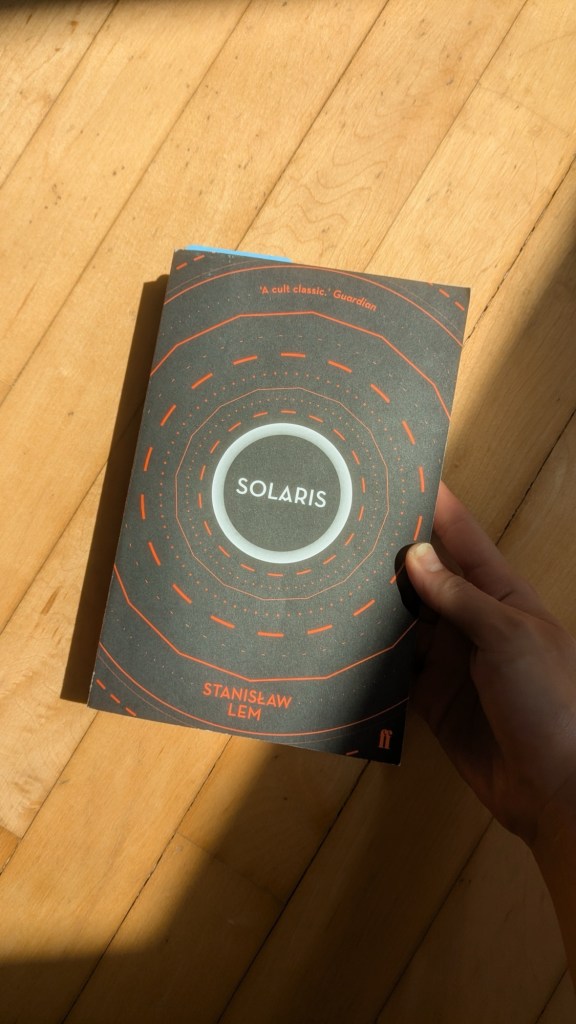
Solaris — timeless, sterile, didactic — is a philosophical exposition on belief, religion, and unknowability of an alien being. The Lathe of Heaven — decidedly vintage, with all the fixings of a 70s sci-fi — explores the ethics of human influence and the dangers of playing God.
I first read Solaris, told from the perspective of a psychologist in space, Kelvin, who finds himself unable (or unwilling) to separate reality from hallucination. The narrative cuts in and out from the current setting to pedantic excerpts from history and research.
I say pedantic not negatively: up in space, amidst the eerie and unfamiliar, you’re submerged in the surreal, and to intersperse this suffocating surrealism with clinical diatribes was a clever move by Lem. The sharp contrast brings you away from the plot, which is a mere vehicle to greater questions the author is asking:
How do we reckon with and pretend to understand a foreign entity – whose motivations, composition and, in fact, fundamental cellular structure so greatly differ from ours? How does our understanding of god, belief, a higher being, reinforce the need to understand and interact with the utter unknown?
Lem has publicly denounced the overwrought film adaptation by Tarkovsky (Solaris, 1972), and along this thread, I genuinely believe he would have turned a few in his grave when Interstellar hit the screens.
But enough of Solaris. We now come to The Lathe of Heaven.
“Everything dreams. The play of form, of being, is the dreaming of substance. Rocks have their dreams, and the earth changes….”
TLoH was a delightful read. Here, plot and idealogy play equal role in moving the narrative, and Le Guin took her liberties and had fun with it. (If you can call multiple ways of envisioning an apocalypse / dystopia fun.) Characters were meticulously and colorfully built.
In both novels, you can truly only name three signficant characters.
Yet unlike the desolation and isolation pervading Solaris, you find breaths of hope and warmth in TLoH. That is not to say you will not be broken by reminders that we are, as human, essentially hapless – despite and because of the influence we can exert on reality.
I love Le Guin’s works and this one did not disappoint. It could very well vie for my top spot from her repertoire (currently, The Dispossessed).
I enjoyed the reading of TLoH, but have to say that because Solaris was so minimalist and atmospheric, it stuck in my mind for much longer. While I did not set out to read these two in succession, I’m glad I did and highly recommend both novels, and reading them together.
Solaris — 4.5/5
The Lathe of Heaven — 4.5/5


Leave a Reply