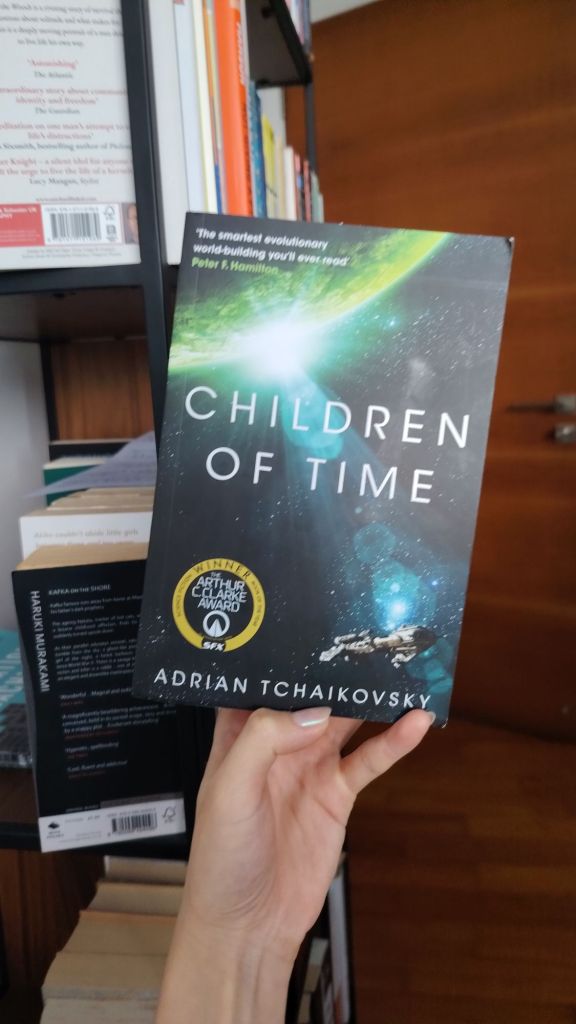
As endorsed, it lives up to being the smartest, most detailed revolutionary world building of all the scifi novels I’ve read around an alien civilisation (and I’ve read a lot of it).
More than Rocky in Project Hail Mary, more than the Pequeninos in Speaker for the Dead, more than the Runa/Ja’anata of The Sparrow, and the Gethenians in The Left Hand of Darkness.
All classic scifi novels exploring fascinating other worldly (literally) species, but none quite so intricately outlining the millenials of evolution, learning, growth, and culture.
It also brought up some real tough and big questions about humanity, morality, and what we stand for.
Is life and humanity worth living for, if you live your entire life in claustrophobic squalor; a life in a makeshift vessel where your lifetime’s work will benefit only generations after you, that you’ll never live to see?
Is immortality – or at least a life spanning millenials – one we would seek, if you’re plucked away from the linearity of time and the natural progression of birth, life, death? If you’re awaken each time to the unknown: you could have landed on a habitable New World, or in the midst of war with an alien species.
And most of all, most difficult of all, the question of who truly “inherits” a world. Who has true claim to a planet. Is it humans, although they’ve torched the one they originally budded from, just because they seeded a new planet? Or the native inhabitants of this new planet, although they themselves bud from the seeds of these alien ancestors?
I found myself not knowing who to side with: The aliens I’ve read about through the generations in this land they call their own, or the humans I share biological makeup with.
If one day we were to evacuate our Earth today, would I also have such strong passions to continue the memories, the genes, the lineage of my kind, at the expense of yet another planet?
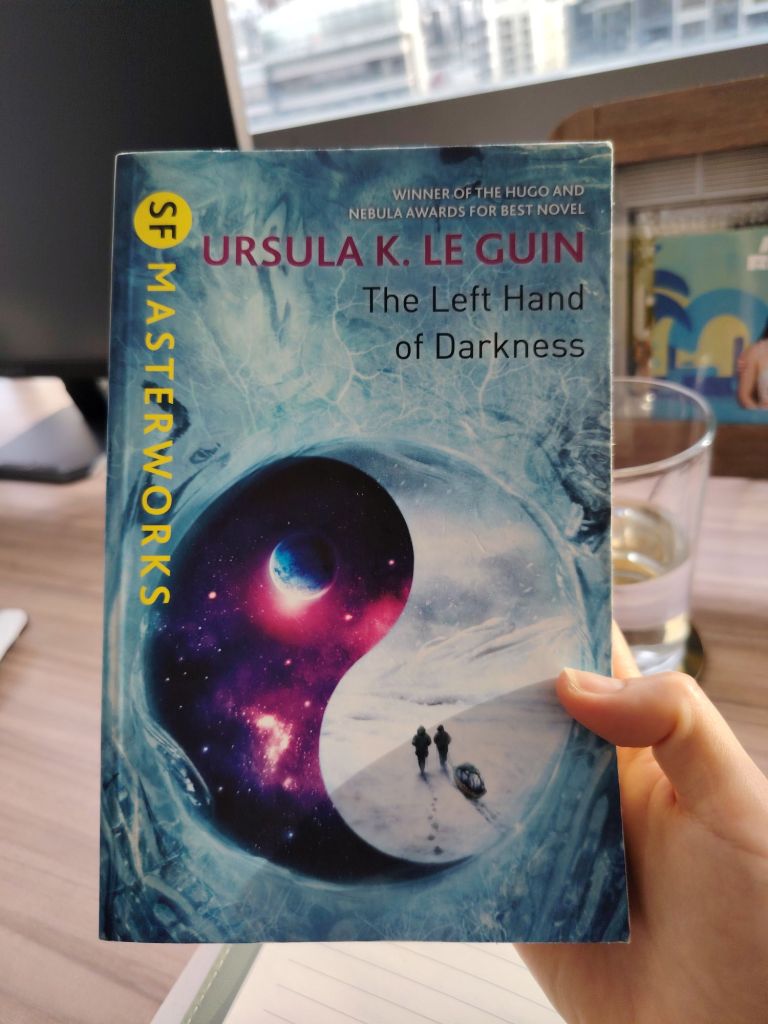
A reader online described the quality of Ursula K. Le Guin’s writing as ‘meditative’. An accurate encapsulation of her style: at once distanced, observational, but not without deep care for her characters and their desires and aches. Reaching the final book leaves, I was not surprised to read that Le Guin was born to an anthropologist and a writer.
Now, this meditative quality is an acquired taste. Truth be told, I started on ‘Left Hand’ years ago, and never got into it, despite it being her most oft mentioned work. Through the gentler entryway of her other novels, this taste I acquired, loved, and came back to ‘Left Hand’, reading it with eyes anew.
The premise is simple though forward for its time (published 1969): Without the human distinction of gender, instead every one being both, what happens to politics, to war, to relationships, loyalties, and taboos?
I had no unrealistic expectations of ‘Left Hand’ providing answers to all these questions, and it does not. Good fiction tells a story, great fiction makes us wonder; its job is not to prescribe or proscribe. Yet, I was left unsatisfied at the gender norms that still pervade in a novel supposedly devoid of gender.
My critique follow many others, laid out in the prologue: the liberal usage of pronouns ‘he’, ‘king’, ‘son’, which color early my conjured images of characters. And most damning of all the ‘feminisation’ of them takes the lazy route of being every negative stereotype, of becoming emotional, weak, mad, physically soft and psychologically indirect.
I choose to be lenient and give its inability to truly transcend gender a literary excuse (narrator bias – as it is told through Genly Ai, male, who came from a world where gender exists and thus cannot abandon these categorisations), for otherwise this book has much to give. These were what I enjoyed:
We follow Genly Ai as he navigates the political landscape and perpetual Winter of planet Gethen, both foreign and fatal to him.
Perhaps due to my Asianness, I was particularly taken with the concept of shifgrethor: that which governs interactions through some layers of face-saving, hierarchy, and politeness. Just as the concept itself which winds and wends around the truth, the novel never quite got to the point of what it is. I would have loved to understand more of its intricacies and implications.
A bulk of the book devotes itself to a trek / escape through Ice. Glacier wonders, shadowless snow. It made me miss the cold and the snow of my second home. Even the Gethenians, described with their adeptness and knowledge of surviving the cold, made me miss my Polish family.
It would make a visually magnificent movie, so much that I Googled mid-read if such a movie already exists (it does not! to my chagrin).
I wish that director of Dune (the new one) would make Left Hand into a movie! One dreams, one dreams.
This review will be totally biased given my penchant for:
Multigenerational stories (Min Jin Lee’s Pachinko, Yaa Gyasi’s Homegoing, Gabriel Garcia Márquez’s One Hundred Years of Solitude)
Female protagonist / point of view
Anything set in India and/or written by an Indian author
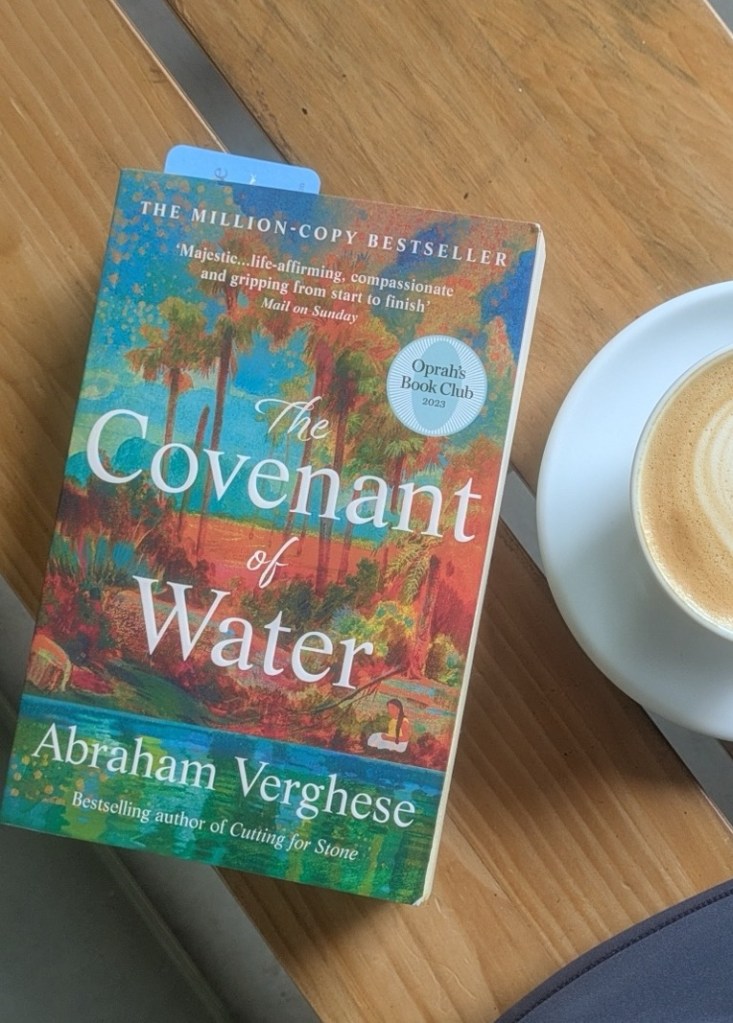
Set in the state of Kerala, along the Malabar coast, this is a watery, evocative novel that takes its time to meander through the river of life. It begins as a bildungsroman of Big Ammachi (as a young bride), branching into multiple characters, interconnected by relationships, maladies, and themes of love, loss, grief, redemption — you know, the usual.
All this is against a backdrop of the Saint Thomas Christian community in Kerala, and historical events spanning the 20th century: British colonialisation and eventual independence, rise of Naxalism, and the shifts – or lack of – in the caste system.
I recommend this for an immersive read, if you want to be convincingly pulled into a tale of heartbreak and hope, of human strength and weaknesses. And especially if you enjoy novels set vividly in a particular place, time, and culture.
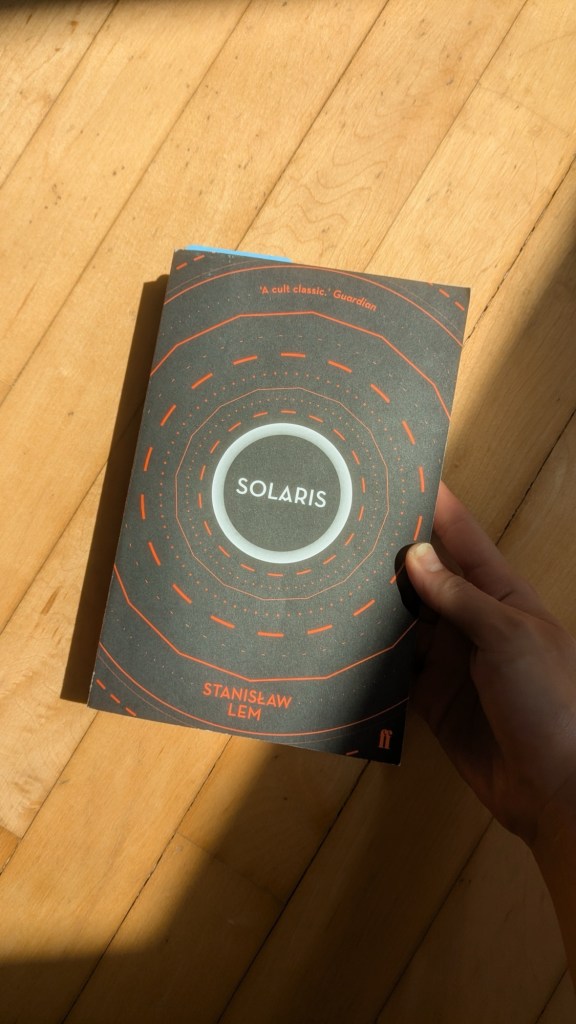
To read Solaris (Stanisław Lem) and The Lathe of Heaven (Ursula K. Le Guin) one after another is akin to having a chain of fever dreams. Both center around bringing creation through imagination, hallucination and dreams; both feature a psychlogiest, and an alien species. Yet, despite their superficial similarities, the two slim novels could not be more different.
Solaris — timeless, sterile, didactic — is a philosophical exposition on belief, religion, and unknowability of an alien being. The Lathe of Heaven — decidedly vintage, with all the fixings of a 70s sci-fi — explores the ethics of human influence and the dangers of playing God.
I first read Solaris, told from the perspective of a psychologist in space, Kelvin, who finds himself unable (or unwilling) to separate reality from hallucination. The narrative cuts in and out from the current setting to pedantic excerpts from history and research.
I say pedantic not negatively: up in space, amidst the eerie and unfamiliar, you’re submerged in the surreal, and to intersperse this suffocating surrealism with clinical diatribes was a clever move by Lem. The sharp contrast brings you away from the plot, which is a mere vehicle to greater questions the author is asking:
How do we reckon with and pretend to understand a foreign entity – whose motivations, composition and, in fact, fundamental cellular structure so greatly differ from ours? How does our understanding of god, belief, a higher being, reinforce the need to understand and interact with the utter unknown?
Lem has publicly denounced the overwrought film adaptation by Tarkovsky (Solaris, 1972), and along this thread, I genuinely believe he would have turned a few in his grave when Interstellar hit the screens.
But enough of Solaris. We now come to The Lathe of Heaven.
“Everything dreams. The play of form, of being, is the dreaming of substance. Rocks have their dreams, and the earth changes….”
TLoH was a delightful read. Here, plot and idealogy play equal role in moving the narrative, and Le Guin took her liberties and had fun with it. (If you can call multiple ways of envisioning an apocalypse / dystopia fun.) Characters were meticulously and colorfully built.
In both novels, you can truly only name three signficant characters.
Yet unlike the desolation and isolation pervading Solaris, you find breaths of hope and warmth in TLoH. That is not to say you will not be broken by reminders that we are, as human, essentially hapless – despite and because of the influence we can exert on reality.
I love Le Guin’s works and this one did not disappoint. It could very well vie for my top spot from her repertoire (currently, The Dispossessed).
I enjoyed the reading of TLoH, but have to say that because Solaris was so minimalist and atmospheric, it stuck in my mind for much longer. While I did not set out to read these two in succession, I’m glad I did and highly recommend both novels, and reading them together.
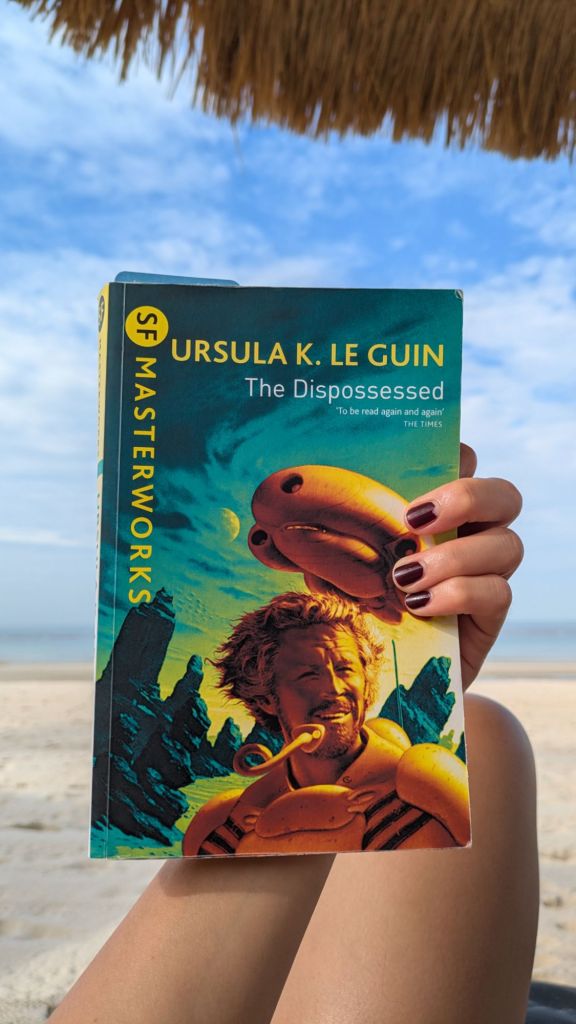
50 years after it’s publication, The Dispossessed remains relevant as ever. Le Guin presents to us a world of anarchy — not dystopian chaos as the word has come to connote (itself telling in our world’s mistrust of decentralization) — but a functioning society without centralized rule, not without its failings.
Le Guin writes with shocking clarity of what a viable anarchy could look like through the eyes of Shevek, a theoretical physicist in anarchic Anarres. Perhaps the true genius lies in her clever juxtaposition with Urras, a capitalist society not unlike ours, to which Shevek travels.
I can do no true justice to this novel through an analysis, and will instead share some choice observations of Shevek, a view of our society through the eyes of a true anarchist.
On anarchic Anarres:
“He could not rebel against his society, because his society, properly conceived, was a revolution — a permanent one, an ongoing process. To reassert its validity and strength, he thought, one need only act, without fear or punishment and without hope of reward: act from the centre of one’s soul.”
“But what keeps people in order? Why don’t they rob and murder each other?”
“Nobody owns anything to rob. If you want things you take them from the depository. As for violence, well, I don’t know; would you murder me, ordinarily? And if you felt like it, would a law against it stop you? Coercion is the least efficient means of obtaining order.”
On capitalistic Urras:
“He had not been free from anything [in Anarres]: only free to do anything. Here, it was the other way round. Like all the students and professors, he had nothing to do but his intellectual work: literally nothing. The beds were made for them, the rooms were swept for them, the routine fo the college was managed for them.”
“The matter of superiority and inferiority must be a central one in Urrasti social life. If to respect him [an Urrasti] had to consider half the human race [women] as inferior to him, how then did women manage to respect themselves—did they consider men inferior? And how did all that affect sex-lives?”
By the recommendation of a dear friend, I picked up this compact novel — a delightful morsel I devoured in two days, putting me in a mood that lasted for even more.
A reviewer described this as a ‘pastoral dystopia’, which is a succinct, accurate description of the setting. I say ‘setting’ specifically, than ‘genre’, because its true genre stripped of the sci-fi cloak, is that of humanness and humanity.
At its core, it is about finding meaning: what it means to be human in context of others, within a community, and especially to be a human woman. It is about how memory, hope, loss, loneliness, and death informs this search.
The dystopian setting is but an excellent vehicle and vessel in the exploration of these themes. The plot is driven by the whats, hows and whys. The characters and reader alike are kept desperate to know the truth of what led to their present. Rather than tiresome philosophical musings of ‘humanness’, these questions naturally arise in the more tantalizing and concrete search for clues on what had happened in this post-apocalyptic not-Earth.
It is a tightly written novel, every word serving their purpose. And in its simplicity of prose, the depth of our narrator’s frustrations, joys, and aloneness rings clear — a note of tragedy you cannot rid of in your head after.
Harpman meticulously constructs a world that gives the nostalgia a unique flavor: the narrator always had enough for survival. There was no real, explicit danger. She experienced and witnessed love and companionship, she had a vague concept of a ‘normal life’, though always second-hand and beyond her comprehension. She had a community for most of her life, yet it was fragile, tenuous, and steadily frittering away.
The implicit confusion, longing, and displacement of the unnamed narrator is reminiscent of Kathy H’s yearnings in Never Let Me Go (to be human, woman, loved). And the other 39 women and their opaque, not quite reachable memories of a past life? They are a neat parallel to one of my favorite post-pandemic wasteland fics, Station Eleven. If you liked either books, you will likely enjoy this title.
I recommend listening to the Carpenter’s rendition of The End of The World as you read, or after you read this. It will do a number to your heart.
Now if you have a masochistic streak and want to sink into the sublime pit of dystopian nostalgia (yup, join the gang), try also Anyone Who Knows What Love Is, a choice pick from one of the earlier Black Mirror episodes.
A slow, passionate, depraved, descent into madness.
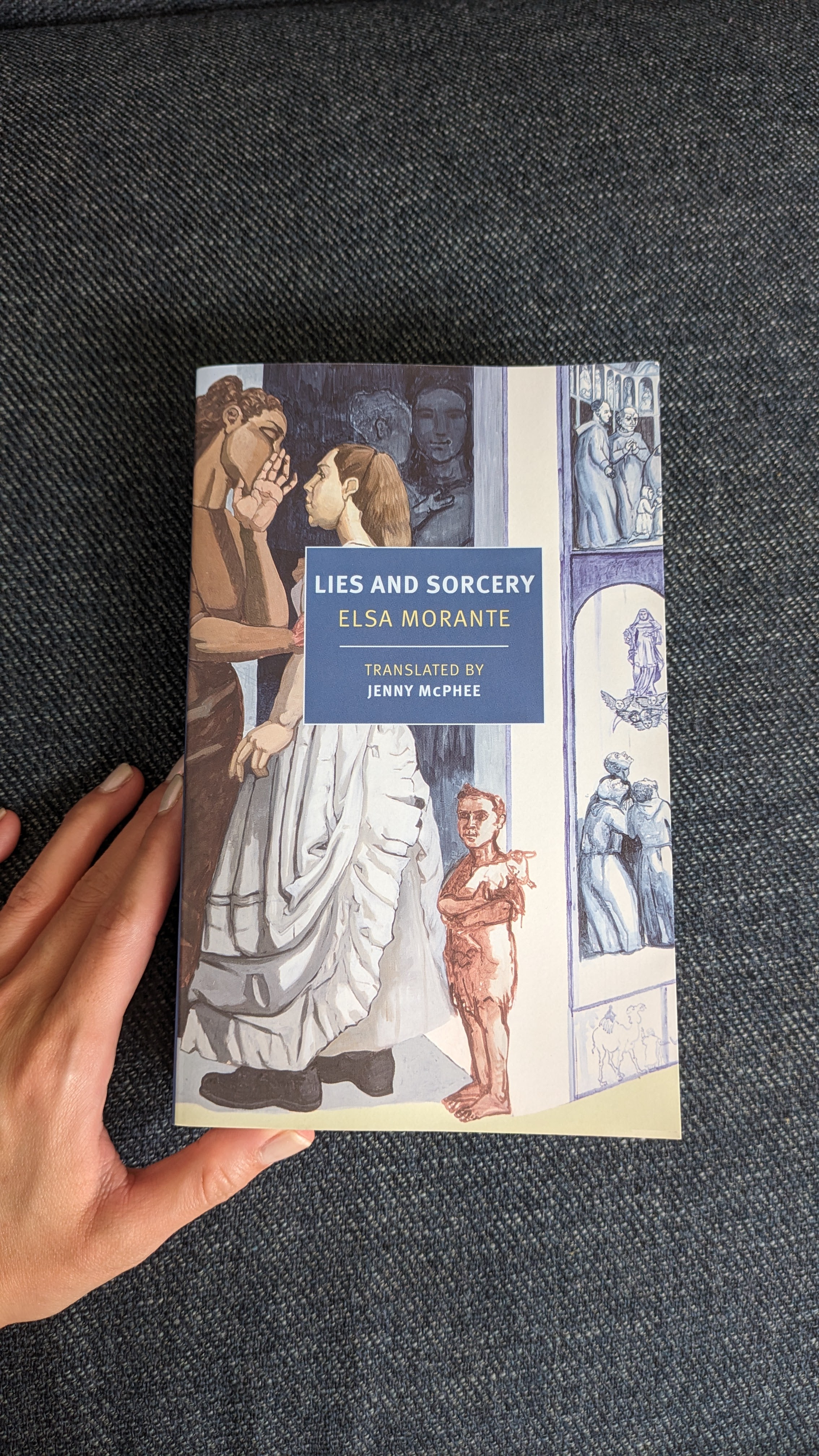
Elsa Morante is a master at writing characters to life: each of them with their secret desires and fears unspooling like tangled yarn, knitted together into a quilt of inextricable insanity.
And borrowing from her genius, our dear, ‘poor’ Elisa – by-product and narrator of the insanity – inherits the masterful metafictional writing of Elsa in her own retelling. At no point of her narration did I doubt the necessity of Elisa’s enervating and painful detailing of her memory.
For those brave enough to venture forth into this complex multi-generational family drama, let it be foretold: the last two parts (400 pages long) felt like being trapped in a fever dream; a dream in which you descend an infinite and illusory stairwell that never ends and is the same as the last turn.
Yet, it all made sense in context of Elisa’s position and motive: while Elsa is an ingenious writer (and cannot be forgiven were she the narrator), Elisa is decidedly not one. This is the reason I not merely tolerated, but perversely relished, the spiraling labyrinth of delirium that spanned 300 pages when it could have been 3.
I love flawed characters, and in this novel you will be hard-pressed to find a single character not flagrantly flawed. I surprised myself by finding the capacity to be heartbroken for some of them (namely Francesco, Alessandra), and noted that this is not a reflection of any redeeming qualities they may have, but the depth of cruelty others’ flaws have flagellated them by.
Indeed, this is a story about heartbreak, cruelty, delusion, derision, and obsession disguised as love. I loved it, docking one star only because I feared that if it were 2 pages longer I would have myself succumbed to lunacy.
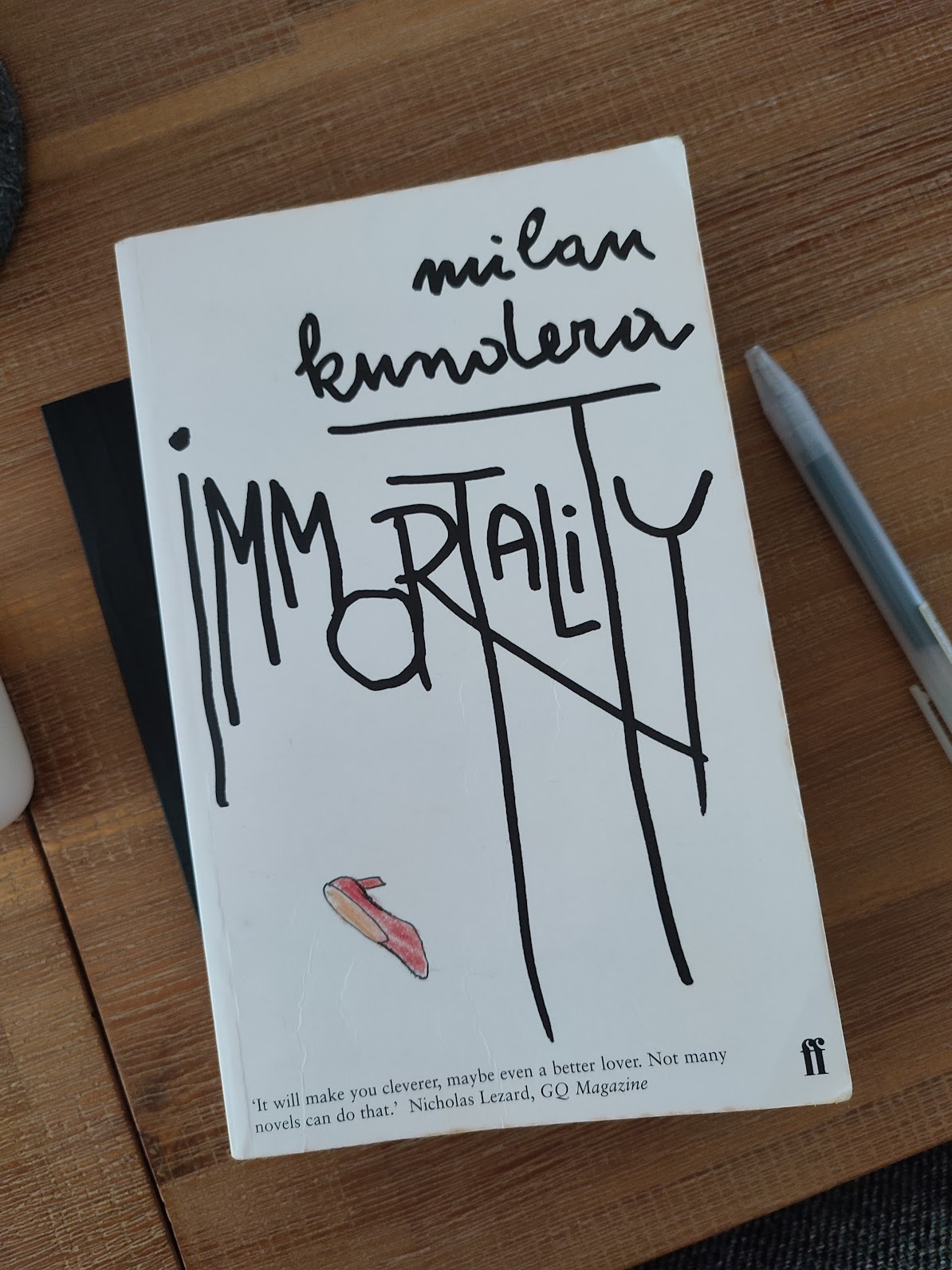
As its title suggests, the novel is one of seeming paradoxes that come into focus as perfect parallels. Milan Kundera’s works are at once Brechtian yet decidedly romantic. The Unbearable Lightness is a concise testament to his literary style. The exposing of fictive and literary techniques; the non-chronological narrative placing the climax and ending ahead of its traditional time in a plot; the constant exposition of political ideas, beliefs about relationships, humans, love, life, death, and loss.
While the characters are moulded to be vehicles of Kundera’s exploration of themes / ideals, they are no less nuanced and complex – in fact, much more so – than a character in any other fictional work. Just as with Immortality, it is challenging to not identify and feel strongly for the fictive persons of Kundera’s imagination (borne of an image, a gesture, a sound, a feeling within himself) despite and because of their faults and very human-ness.
I am in love especially with an excerpt in the last page of this novel. You can say I’m pleasantly surprised at how melancholic yet romantic Kundera made the ending. It verges on kitsch, which most of the book expounded on (mostly against). Which makes it suspect as a deliberate and self-reflexive literary choice on the author’s part. After all, as Kundera himself believes, no one can escape kitsch.
She was experiencing the same odd happiness and odd sadness as then. The sadness meant: We are at the last station. The happiness meant: We are together. The sadness was form, the happiness content. Happiness filled the space of sadness.
Kundera crafted a delectable seven-course literary masterpiece. The amount of control he has over the narrative – every dialogue, character, gesture, structure – is astounding. And with this control comes the most self-aware, perfectly orchestrated novel I’ve read in a long time. Like a Brechtian play, the ropes and pulleys are laid out: our heroine is not only fictional, but borne of a gesture the author glanced from another. Weaved into the story are the author’s muses, the story but a vehicle and device.
Yet, you cannot help being drawn in.
I especially related to Agnes, our protagonist. Her easy irritation at noise, bodies, negativity, modern chaos. Her need to disappear, to be alone, to not be inconvenienced outside of her own control.
I cannot hate them because nothing binds me to them; I have nothing in common with them.
For posterity: some sections and quotes from the book I held my breath through.
On Imagology.
Are you objecting that advertising and propaganda cannot be compared, because one serves commerce and the other ideology? […] Some one hundred years ago in Russia, persecuted Marxists began to secretly gather in small circles in order to study Marx’s manifesto; they simplified the contents of this simple ideology in order to disseminate it to other circles, whose members, simplifying it further and further, this simplification of the simple kept passing it on and on, so that Marxism became known and powerful on the whole planet all that was left of it was a collection of six or seven slogans, so poorly linked that it can hardly be called an ideology. And precisely because the remnants of Marx no longer form any logical systems of ideas, but only a series of suggestive images and slogans (of smiling worker with a hammer, black, white and yellow men and so on), we can rightfully talk of gradual, general, planetary transformation of ideology into imagology.
Ideology was like a set of enormous wheels at the back of the stage, turning and setting in motion wars revolutions, reforms. The wheels of imagology turn without having any effect upon history. Ideologies fought with one another and each of them was capable of filling a whole epoch with its thinking. Imagology organizes peaceful alternation of its systems in lively seasonal rhythms. […] Ideology belonged to history, while the reign of imagology begins where history ends.
On human rights.
Human rights once again found their place in the vocabulary of our times; I don’t know a single politician who doesn’t mention ten times a day ‘the fight for human rights’ or ‘violation of human rights’. But because people in the West are not threatened by concentration camps and are free to say and write what they want, the more the fight for human rights gains in popularity the more it loses any concrete content, becoming a kind of universal stance of everyone towards everything, a kind of energy that turns all human desires into rights. The world has become the men’s right and everything in it has become a right: the desire for love the right to love, the desire for rest the right to rest, the desire for friendship the right to friendship, the desire to exceed the speed limit the right to exceed the speed limit, the desire for happiness the right to happiness, the desire to publish a book the right to publish a book, the desire to shout in the street in the middle of the night the right to shout in the street in the middle of the night.
On Rationality.
In all languages derived from Latin, the word “reason” (ratio, raison, ragione) has a double meaning: first, it designates the ability to think, and only second, the cause. Therefore reason in the sense of a cause is always understood as something rational. A reason the rationality of which is not transparent would seem to be incapable of causing an effect. But in German, a reason in the sense of a cause is called Grund, a word having nothing to do with the Latin ratio and originally meaning “soil” and later “basis”. […] Such a Grund is inscribed deep in all of us, it is the ever-present cause of our actions, it is the soil from which our fate grows.
On Novels.
The present era grabs everything that was ever written in order to transform it into films, TV programmes, or cartoons. What is essential in a novel is precisely what can only be expressed in a novel, and so every adaptation contains nothing but the non-essential. If a person is still crazy enough to write novels nowadays and wants to protect them, they have to write them in such a way that they cannot be adapted [or] retold.
On Being.
A special, unforgettable moment: She was forgetting her self, losing her self, she was without a self; and that was happiness.
What is unbearable in life is not being but being one’s self.
Living, there is no happiness in that. Living: carrying one’s painful self through the world.
But being, being is happiness. Being: becoming a fountain, a fountain on which the universe falls like warm rain.
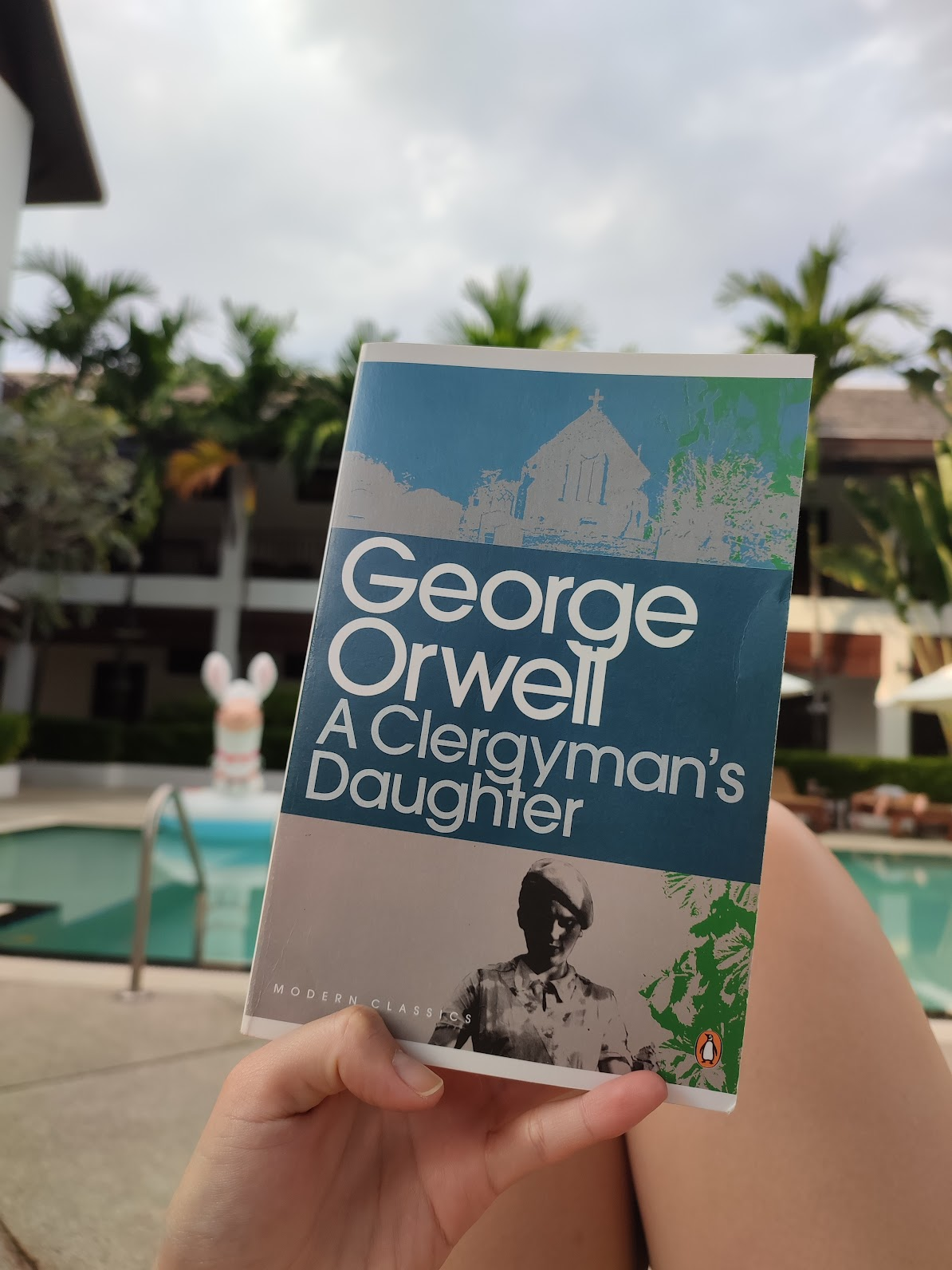
This book was picked up on the whim: I wanted something to read by the pool, on a holiday in Chiang Mai. Chosen purely because it was the one book sitting snug and new in a wrapper, in the bookstore I chanced by.
An orphan of a novel, Orwell himself disowned it and was displeased by its continued publication. My theory: he had set out to write something satirical — an absurd situation and life — only to find it an embarrassingly accurate depiction (of a woman’s life). Put off by the unintended veracity (curses! i am a satirical political writer, not a feminist! thought he.) he disavowed and swore against the title thereafter.
But boy am I glad it was written.
There was something deeply immersive about the inner world and adventures – or misadventures – of Dorothy. The phases in the novel are crisp and concise: her former life, hops picking, as a school teacher, etc. Each section compelling; necessary; brilliantly paced and placed.
What was intended to be a light poolside read had me hooked – on a vacation! I read for hours in the balcony, the pool, the airport, on the plane and savoured each page till the last.
This book doesn’t get lost in itself – it is controlled, coming back to a full circle. Despite all Dorothy has experienced and overcome, she is back at ground zero. This despairing ending by her will and choice, not by her stupidity nor forces of plot. Yet, it was wholly relatable. The entire story has been built so you understand Dorothy’s upbringing, environment, inner beliefs, thoughts, and progression, and how it could have hit that brick wall when the ultimate decision was to be made.
I would go as far as to say this was one of the most raw and truthful depiction of a small town woman’s life in 1930s England I have read.
Now as for the surrounding characters: as much as they were caricatures, Orwell’s satire did a remarkable job at fleshing each one out. True, they were vehicles carrying highly specific socio-political messages. But really, everyone has an entirely disagreeable Rector Hare, a free-spirited and selfish Mr Waburton, and a shit-stirring gossip-monger Mrs Semprill, in their lives. Chances are they play to their caricatures all too well.
My verdict: Every woman should give A Clergyman’s Daughter a read, and find yourself both despairing and relieved. That there are aspects of Dorothy’s helplessness we can relate to; that we have the illusion of choice at times, but in fact not at all. But also that we have come really, really far from where Dorothy was. We have agency and choices that, even when difficult, is freedom in themselves.