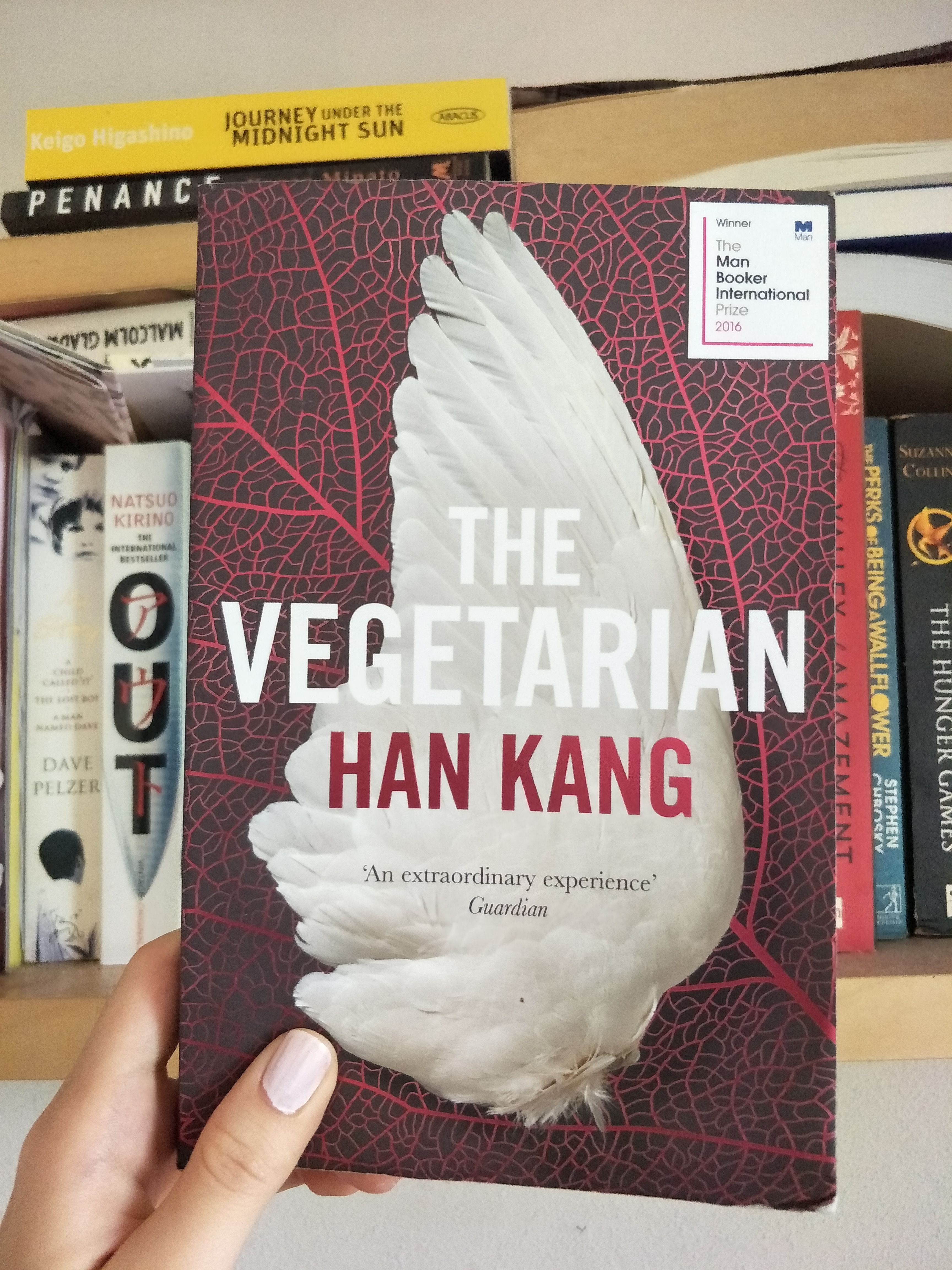
Done with this awhile ago, and I’ve mixed feeling about it.
Some context: my personal preference for style is postmodern plots/themes, but tending towards conventional in structure. Some part of my mind still craves linearity and resolution – although the resolution can be as ludicruous as it wants to.
The Vegetarian treads the line on this.
I fell in love a few pages in, leaning against a stack of books in Eslite bookstore back in Taiwan. I loved the twisted thoughts so plainly, unabashedly, lain down by the first voice (the Vegetarian’s husband). He speaks with undisguised self-awareness, despite being a total asshole. His wife remains a mystery. And that was the hook that i got caught in. Caved and bought the book for 50c more than at Kino!!! (i cheapo)
Thereafter it descended into a bizarre, evocative dreamscape. Inner worlds and images and nightmares blend seamlessly into each other. Beautiful images, by the way. I especially loved the way carnal desire, raw and unrestrained, was contrasted with the pure, the ethereal and sacred. For me the one coherent thematic concern was that of art: when does it become pornographic? Is it the content or intention that determines its sanctity?
Beyond that, I’m slightly disappointed by the lack of insight into the Vegetarian’s head. She’s as much of a mystery – although more frustratingly so – at the end as at the start. Suspense is a hook to only a certain extent. I was waiting for the line and sinker, but got none. Is she just mad? Or was there an internal logic that governs her actions and beliefs? I wanted to be told it’s the latter, but was offered no evidence to claim it.
It was still an engaging read though. I found myself drinking it in easily without getting bored, which is so common these days. The ending was elegantly written, and the pacing felt right, but i needed more of a resolution. Something, anything. It didn’t have to explain everything, but it lacked progression. It might also be the sudden switch in voice to the Vegetarian’s sister that threw me off. I do love switching perspectives, but I’ve been riding a fast train invested in other characters
And to switch to a whole different persona, with different desires and misgivings and wants so late into the novel didn’t feel like a smart strategy. There just wasn’t enough time for me to feel emotional vested in her, and she didn’t feel like the right person to wrap the book up with. If she had given me more about the other’s inner worlds, maybe it would’ve worked. But sadly i cared too little about hers.
In general though, i liked it enough to recommend to G. It’s a nice world to get lost in for a few hours.
“I stood looking over my damaged home and tried to forget the sweetness of life on Earth.”
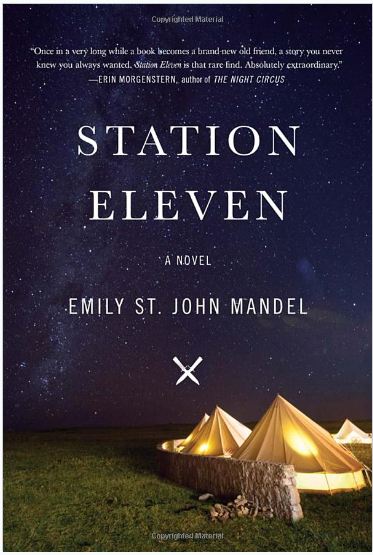
The world is afflicted with a pandemic, and 99% of the population is wiped out. In Year Twenty, a handful of survivors has settled into a makeshift, life post-apocalypse. The almost trite summary of Station Eleven belies a beautiful, profound exploration of what it means to be human on Earth.
The narrative structure is ambitious but successful, selecting an interesting mix of protagonist whose lives are subtly linked along a wide timeline, reaching far back pre-apocalypse and decades after.
One of the most poignant aspects of the novel is the contrast of its central themes. Characters before the virus struggle for an identity in modern society; deal with the urban depression of dead-end careers and iPhone zombies.
In the post-apocalyptic world, skeletons of modern technology lie in plain view; nonfunctional. There is the sweet, pressing desire for a once powered world that is but a fantastical dream. It is this melancholy of a world lost that most strongly draws me to this novel.
Mandel accurately, almost eerily, writes the yearning of man who has experienced and lost Earth as we know it. It’s fascinating how she can reach into such depths of longing while we still live in an age thriving with modernity. This desire of Earth and home is amplified through a tasteful metafiction of Dr Eleven.
Beyond that, Mandel’s writing is on point. She does not just tell a story, but creates a scene. I leave the novel with vivid images in motion. Her word-crafted cinematics are seamless, not excessive enough to tax the imagination. She also does deaths stunningly, strips it of its melodrama and honors them with a grace. And yes, there are plenty of deaths. What did you expect?
The most striking reflection I had was on the human will to survive. In the months following the sudden endemic, the stranded survivors were still waiting for a rescue team to arrive, as it always had. Decades after, even, there is the hope that makes one look up and anticipate an aircraft.
I wonder, in the first few years post-virus – all your family (and most of humanity) gone, what makes one want to live on? When it feels like you’d be the only one left on Earth, or else live threatened by nature and other feral survivors, isn’t death a more desirable choice?
I guess at the core of it, it’s really blind hope that keeps us going. Optimism contradicting all rationality, a human fallacy that propels us to survive beyond good reason.
Recommended to me by a fellow dystopian novel lover. In summary – it has a great premise and the plot development did it full justice. What didn’t live up to its potential is the execution.
Things I liked:
Character development. I loved Conner, the protagonist. He had a distinct personality and motives, he was flawed, he experienced growth throughout the novel. Lev’s break from his initial beliefs was also very compelling! You know he was less one-dimensional than he appeared to be as a tithe, and this glimpse of him slowly came to view as the story progresses. Even the antagonist, Roland, was complex and believable. The dialogue was also well-written – especially loved Hayden and CyFi’s.
The premise and plot. Shusterman uses what we already have now, and projects it into a plausible future. There’s a slight spiritual twist to it, what with all the philosophical consciousness, but moving scenes and situations were weaved with his fresh concept. An upcoming spoiler here***: one of the ending chapters of Harlan’s parts being united was so chilling. I felt waves of goosebumps all over me. Also one of the few scenes that was well-written.
What I didn’t like:
The execution. Especially at the beginning, instead of presenting a scene or action, the story is bared out in plain narrative. There didn’t leave much for the reader’s inference, and was thus not as engaging as it could be. I love it when dystopian novels do not explicitly explain the world, instead unfolding a scene and allowing the reader to learn about it. It shows me that the writer respects my intelligence enough to keep things implicit. Unwinding had a tendency to spell things out as they were, which i found slightly jarring in the beginning.
The pacing was also quite poor. Some parts felt like rush jobs. There wasn’t a proper build-up, which left certain bigger events quite anti-climatic or inappropriately abrupt. The book is relatively short, so I feel like it could be expanded more for proper pacing. Given how compact it is though, it did a fantastic job developing plot and character.
Yesterday I was up till 3am reading this contemporary fiction. This is surprising because usually my off-switch is activated at 11pm, and I’d drift into unconsciousness by 12. I’m not sure if it’s a compelling novel, or if my coffee was too strong that morning – but anyway, I finally finished it today morning.
I have contradictory feelings on this one, summed up by my description of it as a family drama through and through. It engrosses you, but on a more basal than intellectual manner. It is akin to watching a Korean soap. You can’t stop because it spurs on feelings of injustice and morbid fascination we all face towards another family’s misfortune; but it so blatantly flouts literary rules and common sense, it’s hard to tout it as a work of genius.
Most glaringly, it fully exercises the Idiot Plot trope, which in – oh idk – EVERY SINGLE ASIAN DRAMA THERE IS. Seriously, each family member basically lived out extreme misery, inflicted upon one another, just because no one fucking tells each other anything. It’s difficult to sympathize with the characters when they could’ve prevented their predicament by simply saying, “I want to pursue a medical degree, can we find a way to do this?” instead of backing out of your children and husband’s lives soundlessly to re-enter school. I mean. Just.
The one redeeming hook of this novel, and which makes it a family drama at its very core, is the uninhibited use of pathos. Idiot Plot though it is, the family is driven straight into the cesspit of guilt and anger and loneliness – a wreck you cannot turn away from. It is also decently written, with all the tones of Jodi Picoult and assorted mainstream contemporary. Because I’m not a hipster, mainstream does not take on a negative connotation: it’s everything pretty and distilled, neat and sufficiently arousing to the very same emotions that compel housewives to soap operas.
It’s not that I’m a snob, but after sinking into the same contemporary narratives, I’m craving a little post-modern. Not in obnoxious amounts, but just something more offbeat and able to slice through thick indulgent pathos.
Holidays bloat up my recreational activities. Unable to walk for long distances or take jogs this time round, i’ve succumbed to the slothful activities of reading and watching shows and snacking in bed. I haven’t been able to find really good books recently, and my reading list is pitiful relative to last holiday’s. But still. A short run through of this season’s hits and misses, will probably do a more in-depth recommendation later.
READS
HIT – Pastoralia by George Saunders
Pastoralia is a compilation of Saunders’ short stories. This is breathtakingly masterful writing. The premise itself is novel: think a displaced time and space where things work differently, but not impossibly so. Pastoralia, the cover story, is set in a museum where humans are made to live the life of people in different eras (protagonist a caveman) for the entertainment/pleasure of others. Simple enough, but Saunders method of unfolding the setting is absolute genius. I love most his relinquishing of explicit telling, and his expert narration of the protagonist’s throughts (it’s almost poetic). Also the irony that always follows behind his stories, sort of like a superior Catherine Lim without the pompous use of language. In fact that’s a better analogy than i thought: most of their stories slant towards social critique.
I can go on and on about Saunders, but not for this post. I’ll read more of his works before recommending them all at a go. So far i’ve only read Semplica Girl Diaries and Pastoralia.
MISS – For the Time Being by Ruth Ozeki
This was extremely disappointing because 1) it had rave reviews 2) JAPANESE AUTHOR. I usually love their work! But i guess my benign racist generalization backfired. I didn’t like how self-conscious and self-referential Ozeki was. It was too indulgent and explicit, leaving a squeamish, awkward aftertaste when reading. Ozeki was trying too hard to highlight Japanese elements (i should have seen it coming… Zen Buddhist nun, Hello Kitty lunchbox, Japanese tsunami….)
I guess what i love about Japanese novels that i love is their embodiment of the Japanese wabi sabi spirit. A distilled, quiet, intense but controlled aesthetics in writing and telling. Ozeki violates this on all fronts. It screams: I AM JAPANESE LOOK AT MY OTAKU HELLO KITTY MAID CAFE ZEN ZEN. Frankly i found it very offensive. This book made me very angry.
SEMI-MISS – One Hundred Years of Solitude by Gabriel Garcia Marquez
Gabriel Garcia Marquez writes LENGTHY novels. Not Harry Potter action-packed lengthy, but ‘i am going to retell decades of their lives’ lengthy. I read Love in the Time of Cholera, and loved it, lengthiness and all. This one stretched my patience by spanning seven generations. I had trouble keeping up with the new people with similar names, which kind of disrupted the flow of reading for me. I only have my own inadequacy to blame here, therefore the semi-miss. To be fair, the first half of the book before the characters started inter-breeding, dying, and spawning, was very captivating – in the typical GGM way.
I’d say this was still a good book overall, but a challenging one to read.
EATS:
HIT – Snickerdoodle Snackimals!!!
CINNAMON COOKIE GOODNESS. And the best part??? ORGANIC GLUTEN-FREE SUPER HEALTHY! To be honest i have no idea what gluten-free or organic really means, except that it’s more expensive. But this one does taste much more wholesome (but just as yummy) than other cookies in the market, and they are in tiny bite-sized pieces. This means you don’t get that sick buttery jelat feel and can probably finish the entire (quite huge) pack in a day.
ALSO THEY COME IN ANIMAL SHAPES. What is there not to love!? Only drawback: VERY ADDICTIVE.
MISS – Peanut Butter Snackimals
You’d think no one can screw up PB, but they did. Following the success that was Snickerdoodles, i got a pack of PB. It was flat and crispy, tasting vaguely like salty chips? Eugh. Anyone wants i will give away mine.
TV:
HIT – Legend of Zhen Huan / Empresses in the Palace / Zhen Huan Zhuan
Started watching this on Kejun’s recommendation. Up to Episode 30 right now, so yes – definitely addicted. This is available HD on YouTube! Yeah okay everyone mocks me for watching something so cheena, but MOCK ALL YOU WANT. It is worth it! The intelligent well-written script in all its superb subtlety and nuances, SO INCREDIBLE. The plot also avoids the pitfalls of predictability just to please the crowd… it portrays human desires and failings very, very truthfully. Usually i shun away from shows where tragedies occur, because my weak heart cannot take it. But this one – you can’t stop. THINGS – BLOODY AND HEART-BREAKING THINGS HAPPEN. BUT IT IS SO GOOD YOU WATCH IT AND TAKE IT – HEARTBREAK AND ALL.
Songs:
HIT – STRFCKR’s older albums
Recently i re-listened to Starfucker’s earlier works in a bout of nostalgia. Introduced it to Justin, who can be quite stingy with his music preferences. He approved of it! So it must be pretty good… not that i didn’t know that already. I’m nostalgic for the all the good earlier works of my favorite bands. Is it bad that i avoid listening to their new pieces, because i’m afraid of disappointment?
That’s all for now. OH and also i’d be watching Inside Llewyn Davis soon.
HIT – Inside Llewyn Davis soundtrack
Some movies are made pretty good by virtue of their soundtrack. Garden State was one of them. Hopefully Llewyn Davis too. xx





 Q
Q 