Kindly sponsored by my dear friend Xin, we watched the last and matinee show of VAMPYR at the Drama Centre Theatre.
Beginning with a lot of ha-ha-has and hoo-hoos, jangly bones, halloween-esque faces pulled, our vampiric duo made their entrance. It was a long entrance. For the first what felt like minutes, I was tickled and mildly impressed by their physicality, quality of voice.
After awhile I felt bad that this sequence was not garnering the laughter it obviously was soliciting. Was I amused? Yes! Was I guilty enough to fake laugh a little? I did.
VAMPYR was entertaining enough.
Some sequences, imageries, and moments held their own. And of these, a few were held too long, and broke the spell.
While I enjoy a good multi-use metaphor, the somewhat ham-fisted and shallow usage of its titular vampire left me wondering. While I get that the night shift workers’ nocturnal and poor working environment made them as good as the undead, the blood-sucking ways of corporations made them vampires, and literal vampiric bats were impacted by the greenwashing… what was the ultimate intention of the running metaphor?
What was similar about them, or are we highlighting a contrast? In any case, despite the continuous delight in hammering in this metaphor, it seemed to have no further meaning besides being a nifty gimmick.
Things I would have liked to see:
More showing, less telling (most of the revelations came through exposition, which was a waste). More leveraging of the actors extraordinary talent, with their bodies, their voices, and chemistry.
More precision and conciseness. They could have shaved a good 20 min off and made it extra good.
More consistency. The nature of these vampiric beings switch in and out. I do not mean between the three vampiric metaphors, but even within each, there was too great a variation in movement, speech, even costume, for me to grasp a ready line that weaves the bigger picture together.
A sequence of things happening, and a story, somewhat. I’m glad to have watched it anyway, if not purely for a good time and entertainment. It could, and had very real potential to, have had more depth to it.
Also, for a play about greenwashing, they sure use a lot of plastic! (Joke. I’m sure they recycle. But it was a lot.)
This review will be totally biased given my penchant for:
Multigenerational stories (Min Jin Lee’s Pachinko, Yaa Gyasi’s Homegoing, Gabriel Garcia Márquez’s One Hundred Years of Solitude)
Female protagonist / point of view
Anything set in India and/or written by an Indian author
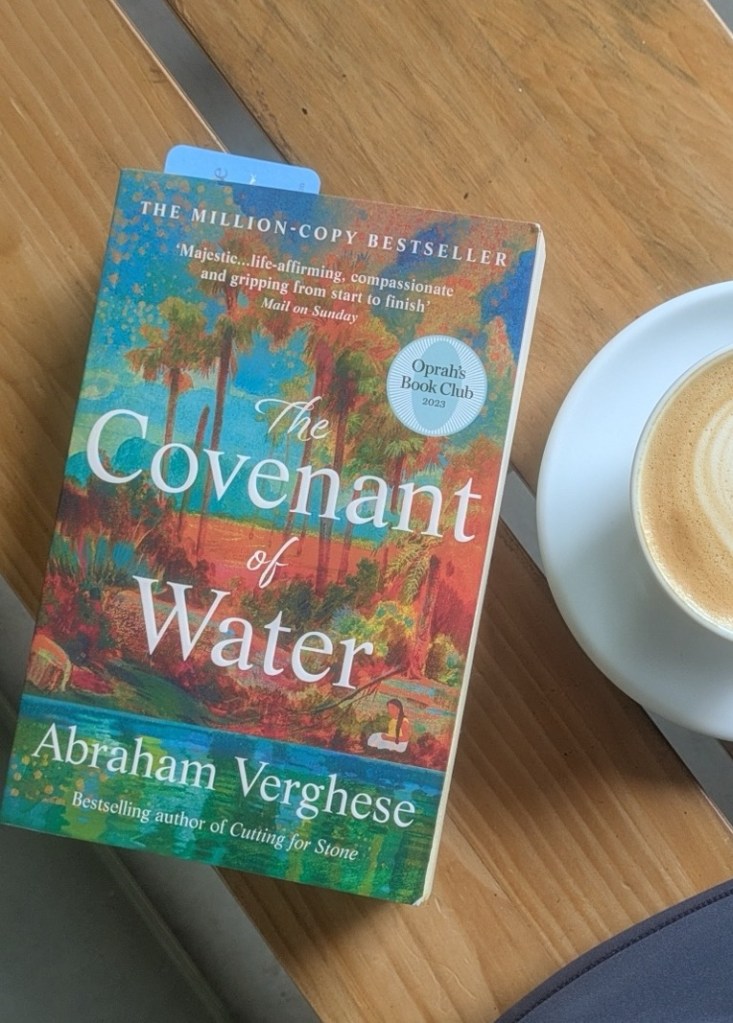
Set in the state of Kerala, along the Malabar coast, this is a watery, evocative novel that takes its time to meander through the river of life. It begins as a bildungsroman of Big Ammachi (as a young bride), branching into multiple characters, interconnected by relationships, maladies, and themes of love, loss, grief, redemption — you know, the usual.
All this is against a backdrop of the Saint Thomas Christian community in Kerala, and historical events spanning the 20th century: British colonialisation and eventual independence, rise of Naxalism, and the shifts – or lack of – in the caste system.
I recommend this for an immersive read, if you want to be convincingly pulled into a tale of heartbreak and hope, of human strength and weaknesses. And especially if you enjoy novels set vividly in a particular place, time, and culture.
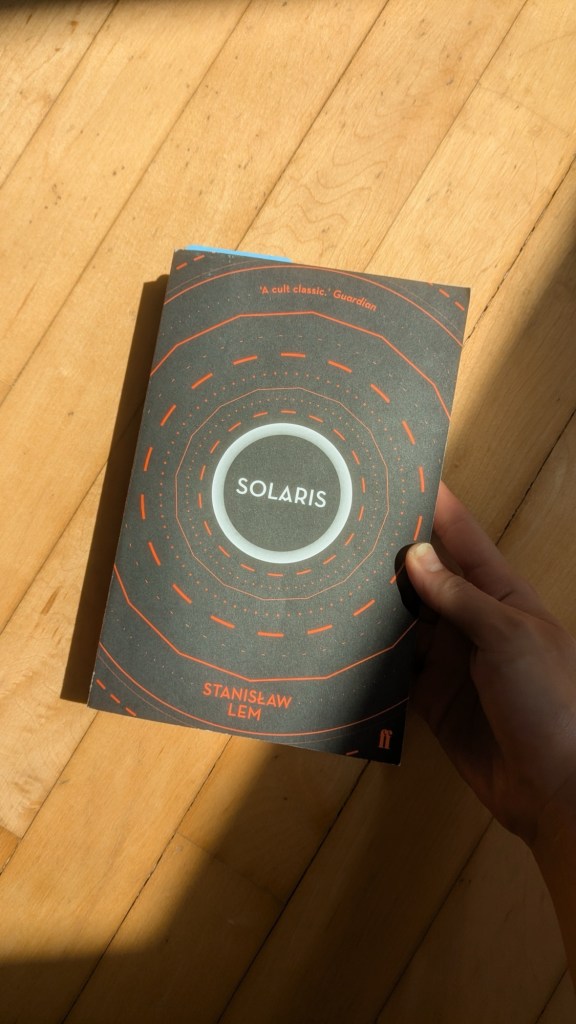
To read Solaris (Stanisław Lem) and The Lathe of Heaven (Ursula K. Le Guin) one after another is akin to having a chain of fever dreams. Both center around bringing creation through imagination, hallucination and dreams; both feature a psychlogiest, and an alien species. Yet, despite their superficial similarities, the two slim novels could not be more different.
Solaris — timeless, sterile, didactic — is a philosophical exposition on belief, religion, and unknowability of an alien being. The Lathe of Heaven — decidedly vintage, with all the fixings of a 70s sci-fi — explores the ethics of human influence and the dangers of playing God.
I first read Solaris, told from the perspective of a psychologist in space, Kelvin, who finds himself unable (or unwilling) to separate reality from hallucination. The narrative cuts in and out from the current setting to pedantic excerpts from history and research.
I say pedantic not negatively: up in space, amidst the eerie and unfamiliar, you’re submerged in the surreal, and to intersperse this suffocating surrealism with clinical diatribes was a clever move by Lem. The sharp contrast brings you away from the plot, which is a mere vehicle to greater questions the author is asking:
How do we reckon with and pretend to understand a foreign entity – whose motivations, composition and, in fact, fundamental cellular structure so greatly differ from ours? How does our understanding of god, belief, a higher being, reinforce the need to understand and interact with the utter unknown?
Lem has publicly denounced the overwrought film adaptation by Tarkovsky (Solaris, 1972), and along this thread, I genuinely believe he would have turned a few in his grave when Interstellar hit the screens.
But enough of Solaris. We now come to The Lathe of Heaven.
“Everything dreams. The play of form, of being, is the dreaming of substance. Rocks have their dreams, and the earth changes….”
TLoH was a delightful read. Here, plot and idealogy play equal role in moving the narrative, and Le Guin took her liberties and had fun with it. (If you can call multiple ways of envisioning an apocalypse / dystopia fun.) Characters were meticulously and colorfully built.
In both novels, you can truly only name three signficant characters.
Yet unlike the desolation and isolation pervading Solaris, you find breaths of hope and warmth in TLoH. That is not to say you will not be broken by reminders that we are, as human, essentially hapless – despite and because of the influence we can exert on reality.
I love Le Guin’s works and this one did not disappoint. It could very well vie for my top spot from her repertoire (currently, The Dispossessed).
I enjoyed the reading of TLoH, but have to say that because Solaris was so minimalist and atmospheric, it stuck in my mind for much longer. While I did not set out to read these two in succession, I’m glad I did and highly recommend both novels, and reading them together.
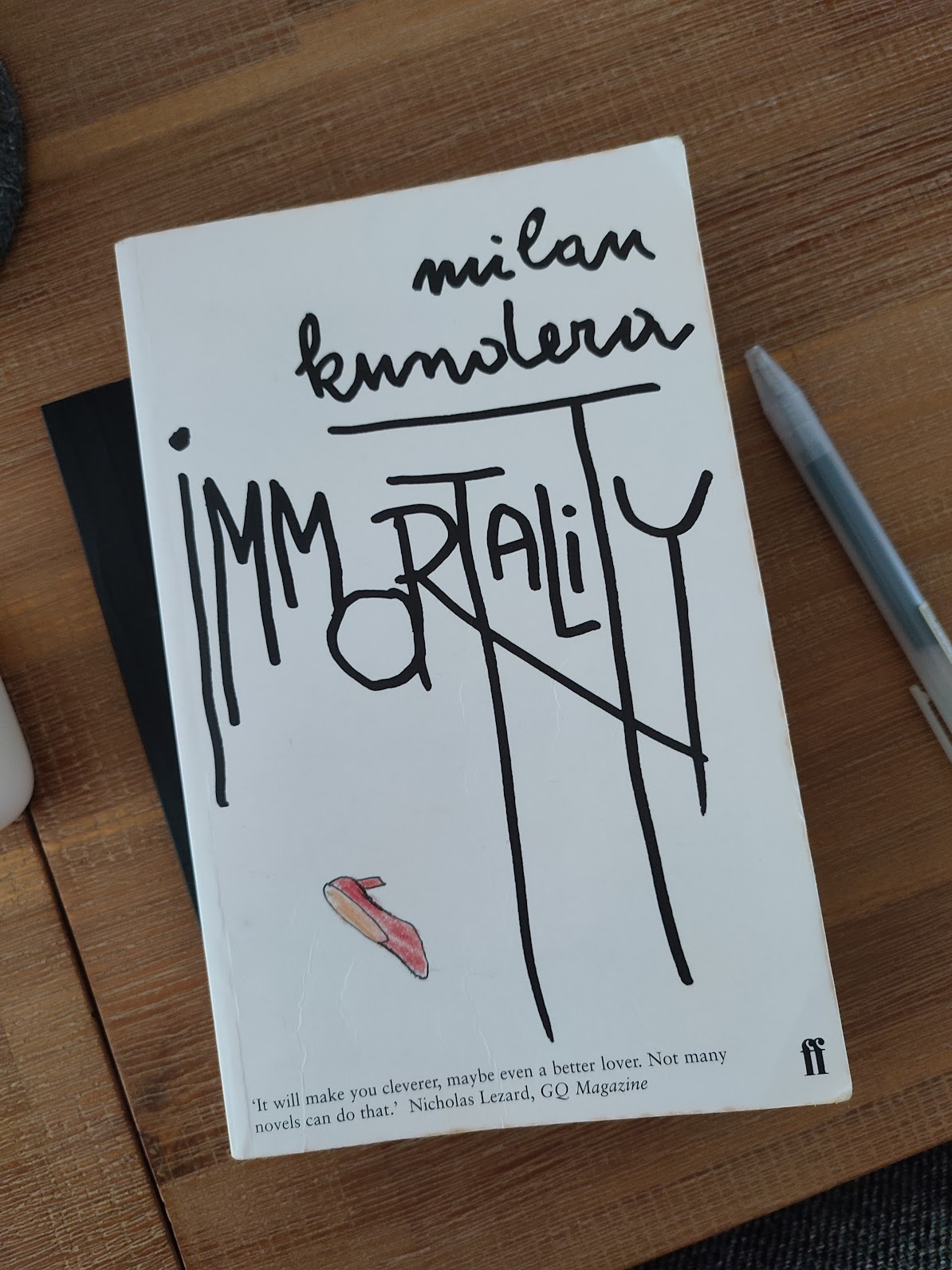
Kundera crafted a delectable seven-course literary masterpiece. The amount of control he has over the narrative – every dialogue, character, gesture, structure – is astounding. And with this control comes the most self-aware, perfectly orchestrated novel I’ve read in a long time. Like a Brechtian play, the ropes and pulleys are laid out: our heroine is not only fictional, but borne of a gesture the author glanced from another. Weaved into the story are the author’s muses, the story but a vehicle and device.
Yet, you cannot help being drawn in.
I especially related to Agnes, our protagonist. Her easy irritation at noise, bodies, negativity, modern chaos. Her need to disappear, to be alone, to not be inconvenienced outside of her own control.
I cannot hate them because nothing binds me to them; I have nothing in common with them.
For posterity: some sections and quotes from the book I held my breath through.
On Imagology.
Are you objecting that advertising and propaganda cannot be compared, because one serves commerce and the other ideology? […] Some one hundred years ago in Russia, persecuted Marxists began to secretly gather in small circles in order to study Marx’s manifesto; they simplified the contents of this simple ideology in order to disseminate it to other circles, whose members, simplifying it further and further, this simplification of the simple kept passing it on and on, so that Marxism became known and powerful on the whole planet all that was left of it was a collection of six or seven slogans, so poorly linked that it can hardly be called an ideology. And precisely because the remnants of Marx no longer form any logical systems of ideas, but only a series of suggestive images and slogans (of smiling worker with a hammer, black, white and yellow men and so on), we can rightfully talk of gradual, general, planetary transformation of ideology into imagology.
Ideology was like a set of enormous wheels at the back of the stage, turning and setting in motion wars revolutions, reforms. The wheels of imagology turn without having any effect upon history. Ideologies fought with one another and each of them was capable of filling a whole epoch with its thinking. Imagology organizes peaceful alternation of its systems in lively seasonal rhythms. […] Ideology belonged to history, while the reign of imagology begins where history ends.
On human rights.
Human rights once again found their place in the vocabulary of our times; I don’t know a single politician who doesn’t mention ten times a day ‘the fight for human rights’ or ‘violation of human rights’. But because people in the West are not threatened by concentration camps and are free to say and write what they want, the more the fight for human rights gains in popularity the more it loses any concrete content, becoming a kind of universal stance of everyone towards everything, a kind of energy that turns all human desires into rights. The world has become the men’s right and everything in it has become a right: the desire for love the right to love, the desire for rest the right to rest, the desire for friendship the right to friendship, the desire to exceed the speed limit the right to exceed the speed limit, the desire for happiness the right to happiness, the desire to publish a book the right to publish a book, the desire to shout in the street in the middle of the night the right to shout in the street in the middle of the night.
On Rationality.
In all languages derived from Latin, the word “reason” (ratio, raison, ragione) has a double meaning: first, it designates the ability to think, and only second, the cause. Therefore reason in the sense of a cause is always understood as something rational. A reason the rationality of which is not transparent would seem to be incapable of causing an effect. But in German, a reason in the sense of a cause is called Grund, a word having nothing to do with the Latin ratio and originally meaning “soil” and later “basis”. […] Such a Grund is inscribed deep in all of us, it is the ever-present cause of our actions, it is the soil from which our fate grows.
On Novels.
The present era grabs everything that was ever written in order to transform it into films, TV programmes, or cartoons. What is essential in a novel is precisely what can only be expressed in a novel, and so every adaptation contains nothing but the non-essential. If a person is still crazy enough to write novels nowadays and wants to protect them, they have to write them in such a way that they cannot be adapted [or] retold.
On Being.
A special, unforgettable moment: She was forgetting her self, losing her self, she was without a self; and that was happiness.
What is unbearable in life is not being but being one’s self.
Living, there is no happiness in that. Living: carrying one’s painful self through the world.
But being, being is happiness. Being: becoming a fountain, a fountain on which the universe falls like warm rain.
I finally got around to Black Mirror’s 2014 Christmas special yesterday, after putting it off in my reluctance to clean Black Mirror off my to-watch dock. It was – if i were to be succinct than loyal – disappointing. First things: I’m very new to (and very much in love with!) the Black Mirror universe. In fact, i started it because the release of White Christmas rejuvenated its fan base. Series 1 & 2 was completed within two weeks, so my inclination to compare runs rather high.
Even as the weakest BM episode, it was engaging enough for > 1 hour to feel much shorter than it was. Again, the actors were on point; i do have a penchant for british actors – there’s always a faint shadow of stage in their performance, which appeals to my early years in theatre. Jon Hamm worked in contrast to the cast, especially in context of his character – more offhand and quick charm.
Also, not sure if it’s just me, but little segments (technology, songs, dialogue, plot) reminiscent of past episodes. Perhaps hidden tributes?
That’s pretty much all for that was commendable though. The most glaring of its faults was its over-dependence on thought experiments. In previous BM episodes, i gave full pardon for leaps of logic – because it was psychologically water-tight. Meaning, the episodes often sliced off a narrow piece of universe on which the premise is centered, without considering possible external factors, or how this might work in context of the actual world (e.g. crime logic in National Anthem? what does everyone else do? in 15 Million Credits, governmental intervention in White Bear?). BUT, the courses of action taken within that assumed universe followed its rules, and closely mimicked what anyone would do in the situation. Given that the premises are primarily thought experiments, the external world doesn’t play as crucial a role.
In White Christmas however, even within the given universe, the plot is sketchy. Firstly, surely the cookie cannot be seen as viable. It’s unlikely that humans, with so much fear and desire for self-preservation, would willingly allow a copy of the consciousness – even if it were code – to be imprisoned. Even more unlikely is that they would use the technology to force confessions out of lower level crimes. It could only imply that the technology is widespread and inexpensive. If it were, it suggests that there should be more sophisticated methods available that could extract a consciousness that coded pure informational memory, taking away the whole imprisoned consciousness! conundrum.
The concept of blocking someone could also have been polished. It’s strange that blocking constitutes of making another a huge, conspicuous, static mess who still makes rather loud – albeit muffled – sounds. Isn’t it way easier to tune out another human being than something so unnatural and obviously distinct from everyone else!?
Charlie Brooker wrote this episode, like he did the other amazing ones. I can only guess that the pressure of an 80 minutes episode forced his hand at expanding the scope of his new tech theme. In almost all episodes there was a tight and elaborated focus on one technology (social media, memory chips, dead people imitator); in White Christmas it took on both in-person blocking devices and the cookie extractor. Perhaps it was this that muddied his ability to troubleshoot the viability of his tech creations. The moral implications of both technologies were also pretty divergent, without ever converging to deliver a singular message as happened in all other BM episodes. Given that this is the main factor for BM’s success, i’d say White Christmas failed its predecessors.
The last gripe i have is its predictability, which was so, so deliciously absent in all other episodes. Every past episode shocked me in ways my new-media sensation-craving being yearned for (okay yes, i double checked, at least one satiating surprise in each). This episode, however, i knew the kid was Tim’s. Even more offensively is perhaps that Tim wasn’t a casual Asian seamlessly folded into the plot – he wasn’t even a bloody token Asian. HE WAS THERE BECAUSE HIS ETHNICITY PROVIDED A PLOT DEVICE. So we could have Potter immediately recognize the Asian child and realize she’s not his. So: predictable + Asian as convenient plot device otherwise would not have been Asian.
TLDR: I loved Black Mirror series 1 and 2, but was quite disappointed with the Christmas special.
Yesterday I was up till 3am reading this contemporary fiction. This is surprising because usually my off-switch is activated at 11pm, and I’d drift into unconsciousness by 12. I’m not sure if it’s a compelling novel, or if my coffee was too strong that morning – but anyway, I finally finished it today morning.
I have contradictory feelings on this one, summed up by my description of it as a family drama through and through. It engrosses you, but on a more basal than intellectual manner. It is akin to watching a Korean soap. You can’t stop because it spurs on feelings of injustice and morbid fascination we all face towards another family’s misfortune; but it so blatantly flouts literary rules and common sense, it’s hard to tout it as a work of genius.
Most glaringly, it fully exercises the Idiot Plot trope, which in – oh idk – EVERY SINGLE ASIAN DRAMA THERE IS. Seriously, each family member basically lived out extreme misery, inflicted upon one another, just because no one fucking tells each other anything. It’s difficult to sympathize with the characters when they could’ve prevented their predicament by simply saying, “I want to pursue a medical degree, can we find a way to do this?” instead of backing out of your children and husband’s lives soundlessly to re-enter school. I mean. Just.
The one redeeming hook of this novel, and which makes it a family drama at its very core, is the uninhibited use of pathos. Idiot Plot though it is, the family is driven straight into the cesspit of guilt and anger and loneliness – a wreck you cannot turn away from. It is also decently written, with all the tones of Jodi Picoult and assorted mainstream contemporary. Because I’m not a hipster, mainstream does not take on a negative connotation: it’s everything pretty and distilled, neat and sufficiently arousing to the very same emotions that compel housewives to soap operas.
It’s not that I’m a snob, but after sinking into the same contemporary narratives, I’m craving a little post-modern. Not in obnoxious amounts, but just something more offbeat and able to slice through thick indulgent pathos.
I read Gillian Flynn’s Gone Girl on my phone, and was so obsessed with her writing i immediately tore through Dark Places and Sharp Objects. They were all fascinating reads, but in different ways. In Gone Girl, the cutting descriptions of love as it can be: cruel, sour, obsessive, was especially immersive. I found myself hoarding Diary Amy’s words – a fiction weaved within a fiction but almost embarrassingly real.
As a side note, underlying embarrassment should be what compels a writer’s subscription to Mary Sues: the inability to fully recognize or reveal themselves as flawed as they really are. Gillian Flynn’s characters are either superficially polished but severely messed up inside, or else rotten through and through (Dark Places). She doesn’t see the need for a redemptive theme, so eagerly pursued by many American authors (Good triumphs Evil! Bad situation lead to Personal Growth! etc.), which I love and is a feature of a great many Japanese novels.
Beyond the shedding of Mary Sue types, it occurred to me that the most subtle devices employed crafted the most believable characters. As opposed to telling me what or how the characters were, there were little irrelevant details Flynn intersperses into the text:
I take baths. Not showers. I can’t handle the spray, it gets my skin buzzing, like someone’s turned on a switch. So I wadded a flimsy motel towel over the grate in the shower floor, aimed the nozzle at the wall, and sat in the three inches of water that pooled in the stall. Someone else’s pubic hair floated by.
I’m not sure how this tells me something about the character, but it does. It fascinates me how writers can conjure up the most mundane, detailed aspects of everyday life. Is it something they think up on the whim, or an extract from their actual lives? I’d love to try incorporating it to my own writing.


 Q
Q 